All blueberries are not the same. If you run across a recipe that claims you can don’t need to modify the ingredients for fresh versus frozen blueberries, chances are one version will suck. Fresh and frozen blueberries are not the same. They contain different levels of liquid and will produce totally different results when baked. I live in New England where the fields and hills turn into blue carpets during wild blueberry season. You’ll never convince me that fresh, wild blueberries taste or bake the same as frozen berries, because they don’t.
If you made a blueberry pie and it didn’t turn out the way you expected, don’t blame yourself or the recipe. Chances are it was the blueberries. On average blueberries are 85% water. But what about the blueberries you used? If they were frozen the liquid content was higher than 85%. Even if they were fresh berries, the water content might’ve been considerably less than average. Water content in the blueberries affects how your blueberry filling turns out.
How The Type of Blueberries Affects Your Pie
Frozen blueberries release more juice than fresh blueberries when baked. I’ll cover that more in depth below. I’m pointing this out because I recently perused 10 different blueberry pie recipes that all contained misinformation. Frozen blueberries release more juice than fresh blueberries when baked. If you followed a blueberry pie recipe and the pie came out runny, chances are the recipe didn’t include enough thickener.
According to the Oregon State University Extension Service there are five major varieties of blueberries grown in the United States. Each of these varieties is composed of dozens of specific types, called cultivars. I’m pointing this out because commercially-grown blueberries seldom list the variety or type of the berry. You just never know what you’re getting or how the berries will perform in your pie.
Types of Blueberries
Half-High Blueberries
Half-high blueberries are a hybrid between the highbush varieties, which produce large berries, and the wild, lowbush variety, which produces smaller berries. Although half-high blueberries are grown commercially, chances are you won’t find them in your local supermarket.
Low Bush (wild blueberries)
Low bush blueberries are usually called wild blueberries. Although they are grown from Virginia north and east to Minnesota and Maine, the only state worth mentioning is Maine. The State of Maine produces 99% of the wild blueberries sold commercially in the United States. Almost all frozen wild blueberries you’ll find in the store came from the state of Maine. The best known brand of frozen berries is Wyman’s, which is in Maine.
Northern High Bush Blueberries
Northern Highbush blueberries are just that. They are native to the Eastern and Northeastern United States. Most high bush blueberries grown commercially for sale in the United States are Southern high bush, not Northern.
Southern High Bush Blueberries
Most of the fresh blueberries you’ll find in a grocery store are Southern High Bush. These berries are grown primarily in California, Florida, Georgia, Michigan, North Carolina, Oregon, and Washington. As I’ll reiterate throughout this article, high bush blueberries are not recommended for pie baking.
Rabbiteye Blueberries
Rabbiteye blueberries are grown commercially from Virginia and Tennessee, south to Florida and west to Arkansas
and Texas in areas with acidic soils. This is why I’m pointing out that you never know which blueberries you’re getting if you buy them in a grocery store. You never know which type or variety of blueberries you’re picking up at the local grocery store. Even if you’re buying Rabbiteye blueberries, the variety will not be listed on the package.
Storing Fresh Blueberries
Blueberries contain an average of 85% water and should be stored between 31 and 35°F. So it’s okay to buy blueberries from the grocery store and keep them in the refrigerator? Absolutely not! Blueberries maintain their maximum freshness when stored at 90-95% relative humidity. The crisper drawer in your refrigerator is designed to maintain LOW humidity. You shouldn’t store the blueberries in the crisper drawer unless you’re going to be baking that pie today or tomorrow.
I’m mentioning the recommended humidity level for storing blueberries for a reason. Grocery stores keep the blueberries in a refrigerated case but it’s not humidity controlled. Once the humidity level drops below 90%, the skins of the blueberries start to dry and shrivel. I’m sure you’ve seen shriveled blueberries sitting on the store shelf. Someone will walk by and say “they picked them too early.” Nope. The blueberries are dry because they weren’t stored at the optimal humidity level.
Fresh Versus Frozen Blueberries
While frozen blueberries don’t necessarily contain more liquid than fresh blueberries, they do release more liquid while baking. After being picked the berries are flash frozen, which creates ice crystals that break down the cell walls. According to Blueberry.org, this causes the berries to become softer and release more juice during the baking process.
Most experts in the blueberry industry claim that high blush blueberries are not recommended for pie baking. If you’ve ever made a package of blueberry muffin mix, you’ve noticed that the berries are small. Those are wild, low bush blueberries, not high bush. Wyman’s has been harvesting wild Maine blueberries for over 125 years. They are one of the top blueberry providers in the world. Most of the commercially-packaged blueberry baking products you’ll find contain wild Maine blueberries from Wyman’s.
The National Institute of Health conducted extensive studies on the amount of juice released by frozen blueberries. Their conclusion was that blueberries release up to 20% more liquid than they contained before they were frozen. The additional “juice” is a result of the flash freezing/thawing process. This might seem insignificant but it’s important to keep in mind if your blueberry pie comes out more runny than you’d hoped for.
Size of The Blueberries
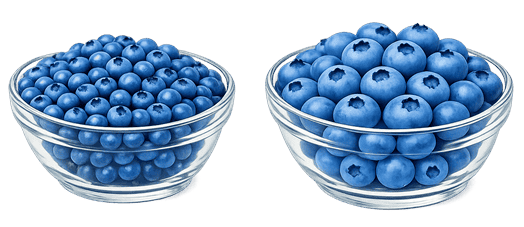
The overall texture and flavor of your blueberry pie filling will directly relate to the type of berries you’re using. An average cup of wild blueberries contains 300-400 berries. An average cup of high bush blueberries contains 65=100 berries depending on the type and variety. That’s a significant difference. The average blueberry pie recipe calls for 5-6 cups of berries. That translates to 1500-2400 wild blueberries and 325-600 high bush berries.
For baking pies you need to keep everything in mind in case your filling comes out too runny. The only way to truly predict the outcome of your pie filling is to use the same berries every time. High bush berries are not recommended for pies. If you make two pies from different types of berries picked up at local supermarkets, the pies might come out different because the blueberries weren’t the same variety or were at different stages of the dehydration process due to the lack of humidity during storage. It’s also possible that the berries from Store A were fresher and contained more liquid than the ones from Store B. If there is a secret to making consistently perfect blueberry pies, it’s to use the same exact berries every time.
Thickening Blueberry Pie Filling
Due to the high liquid content, blueberries must be thickened when baked in a pie. Many recipes don’t mention the purpose of the ingredients but the thickening agents are easy to spot. The most commonly used pie filling thickeners are flour, cornstarch, Clearjel, and tapioca.
If your blueberry pie comes out too runny or the filling is too thick, check the recipe and adjust the thickener the next time you use the same recipe. If it called for 1/4 cup of flour and the filling is too runny, next time add an extra couple tablespoons of flour. If the filling is too thick, next time add less flour.
Key Takeaways
- High bush blueberries don’t bake the same as wild, low bush berries.
- Frozen blueberries release more liquid during baking than fresh blueberries.
- Frozen blueberries usually require more thickener than fresh blueberries.
- Commercially-grown high bush blueberries found in most grocery stores are not recommended for pie baking.
Ready to bake the perfect blueberry pie? The following recipe is quick and easy yet produces a classic blueberry pie. You’ll notice that it recommends defrosting the blueberries before use and saving some of the liquid to add extra flavor to the filling. This is my adaptation of the infamous Wyman’s Blueberry Pie Recipe.
This recipe recommends cornstarch as the thickening agent. If you’re not a big fan of cornstarch you can substitute flour for the cornstarch. Just use 2 tablespoons of flour and omit the cornstarch.
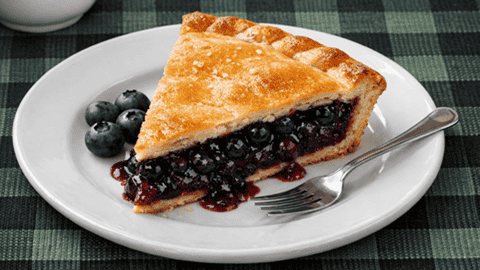
Quick & Easy Classic Blueberry Pie Recipe
Utensils & Equipment
- 1 9-inch deep dish pie plate
- 1 medium mixing bowl
- 1 small bowl
- 1 microwave safe bowl
- 1 spoon or spatula
- 1 wire whisk
- 1 wire cooling rack
Ingredients List
- 5 cups wild blueberries (frozen)
- 1/2 cup granulated sugar
- 1/4 cup light brown sugar
- 2 Tbsp cornstarch
- 2 Tbsp blueberry juice
- 1 tsp cinnamon
- 2 refrigerated pie crusts

Instructions
Prepare Blueberries
- Microwave blueberries on high to defrost.
- Strain the juice from the blueberries and reserve 2 Tbsp to go in the pie.
- Transfer the blueberries to a medium bowl.
Preheat Oven
- Preheat oven to 400℉.
- Place a sheet of aluminum foil on the bottom rack, directly under where you will be placing the pie.
Prepare The Crust
- The crust must sit at room temperature for 15-20 minutes or as directed on the package.
- Place the bottom crust in the pie plate.
Dry Ingredients
- In small bowl whisk together the sugars, cornstarch (or flour), and cinnamon.
Mix
- Pour the dry ingredients over the blueberries and stir well. Stir in the reserved blueberry juice while blending the mixture.
- Stir gently, trying to not crush or break any of the blueberries.
Assemble The Pie
- Pour or scoop the filling into the crust.
- Add top crust and crimp the edges to create a scalloped look.
- Cut at least four slits around the top of the crust to allow the filling to vent while baking.
Bake
- Place the pie on the middle rack, directly over the sheet of aluminum foil that should be on the bottom rack.
- Bake for 40-45 minutes.
- Pie is done when crust is golden brown and filling starts to bubble.
Cool
- Place on wire cooling rack and allow to sit at room temperature for at least 3 hours.